
Conceptual Definition #
Agile Portfolio Management is a core practice area within the Agile Strategy & Portfolio Management competence of the Scrum Enterprise Model (SEM). It is a value-driven, dynamic approach to investment governance that strategically aligns and continuously optimizes resource allocation across evolving product value streams.
Departing fundamentally from traditional project-based, fixed-budget investment models, it shifts organizational focus from one-off project delivery to ongoing product lifecycle stewardship. Grounded in Lean Startup methodology, Scrum’s empirical process control, and value stream thinking, it treats every investment as a testable hypothesis rather than a predetermined commitment. Resources are allocated incrementally based on validated market evidence and strategic priority, rather than static annual forecasts or departmental entitlements.
Within SEM’s four-layer architecture, it operates at the Agile Portfolio layer as the critical bridging mechanism. It translates strategic themes from the strategic layer into actionable product initiatives, and governs downstream resource allocation across product value streams and delivery teams, closing the gap between enterprise strategic intent and frontline value delivery.
Purpose #
Agile Portfolio Management pursues five interconnected strategic objectives within the SEM framework:
- Reinforce Strategic Alignment
It ensures all product investments remain tightly aligned with enterprise strategic themes, preventing resource fragmentation into disconnected, low-impact initiatives. Every portfolio item is traceable to organizational strategic goals, creating a clear line of sight from vision to delivery. - Enhance Adaptive Responsiveness
It enables rapid investment adjustments based on validated learning from market signals and iterative experiments. By avoiding sunk-cost bias and enabling timely pivots, it allows the enterprise to redirect resources quickly as market conditions, customer needs, or competitive dynamics evolve. - Optimize Resource Allocation Efficiency
Through dynamic budgeting and rolling planning mechanisms, it systematically channels resources toward validated high-value opportunities. This improves overall return on innovation investment and reduces wasteful spending on initiatives that fail to demonstrate tangible value. - Systematically Mitigate Investment Risk
It reduces investment uncertainty through continuous assumption validation and market viability testing. Small-scale MVP experiments replace large upfront commitments, allowing failures to be identified early and at low cost, containing downside risk while preserving upside potential. - Balance Exploitation and Exploration
Through a structured horizon-based investment model, it balances optimization of existing core products with investment in adjacent market expansion and disruptive innovation. This builds organizational ambidexterity, sustaining short-term profitability while cultivating long-term growth capabilities.
Core Principles #
Agile Portfolio Management is underpinned by seven foundational principles, each aligned with SEM’s systemic architecture and Lean-Agile theoretical foundations:
- Value-Centric Investment Prioritization
Investment decisions are governed by measurable customer value and strategic return, not by departmental influence, historical budget baselines, or subjective judgment. Initiatives are ranked using quantitative metrics such as Benefit-Cost Ratio (BCR), ensuring resources consistently flow to highest-value opportunities. This principle operationalizes SEM’s value-driven core value at the investment governance level. - Value Stream-Centered Investment Paradigm
Departing fundamentally from traditional project-centric funding models that allocate budgets to time-bound, scope-fixed discrete projects, Agile Portfolio Management channels sustained investment into persistent end-to-end value streams aligned with SEM’s dual value stream architecture (Product Value Streams and Operational Value Streams). Resources and cross-functional delivery teams are organized around continuous value delivery flows rather than temporary project mandates, eliminating the handoff overhead, short-termism, and fragmented accountability inherent in project-based structures. Individual Epics, MVPs, and feature initiatives are treated as incremental investments within an ongoing value stream ecosystem, not as standalone budgetary units with arbitrary start and end dates. This principle ensures portfolio governance prioritizes long-term value flow optimization over narrow short-term project delivery milestones, embedding SEM’s value stream optimization logic at the investment governance layer. - Hypothesis-Driven Validation
All product initiatives are treated as testable hypotheses rather than foregone conclusions. Core assumptions are validated empirically through Minimum Viable Products (MVPs), customer co-creation, and structured experimentation. Funding decisions are based on evidence, not the quality of upfront planning. This principle extends Scrum’s pillar of empiricism from delivery teams to enterprise investment governance. - Dynamic Incremental Resource Allocation
One-size-fits-all annual budget allocations are replaced with rolling budgets and staged funding releases. A 20–30% resource reserve is maintained for high-potential emergent opportunities, and funding is scaled up, scaled down, or withdrawn based on milestone validation outcomes. This ensures resource velocity matches the rhythm of value creation. - Balanced Horizon Stewardship
The portfolio is structurally managed across three investment horizons: Horizon 1 for core product optimization, Horizon 2 for adjacent market expansion, and Horizon 3 for disruptive innovation exploration. Intentional resource balancing across horizons sustains both short-term performance and long-term strategic renewal, embodying SEM’s ambidextrous innovation principle. - Collaborative Transparent Governance
Portfolio governance is conducted through cross-functional representation including product, technology, finance, and market stakeholders. Prioritization processes and performance data are openly accessible, breaking down functional silos and building shared ownership of portfolio outcomes. This principle reflects SEM’s Radical Transparency value and reduces decision bias from information asymmetry. - Lifecycle Product Stewardship
The management perspective shifts from discrete project delivery to continuous value optimization across the full product lifecycle. The portfolio is understood as a living ecosystem of value streams, not a static collection of projects; investment aims to nurture long-term product health rather than complete fixed-scope deliverables.
Practices Across SEM Architectural Layers #
The following practices operationalize Agile Portfolio Management principles at each layer of SEM’s four-tier architecture, translating governance philosophy into actionable, repeatable routines.
Strategic Level #
Practices at this layer establish the top-level framework for portfolio governance and align investment direction with enterprise strategy.
- Strategic Theme Alignment & Portfolio Framing
Based on strategic maps and themes output from Agile Strategy practice, the overall investment direction and boundary constraints of the product portfolio are defined. Target resource allocation ratios across innovation horizons are set to ensure the portfolio structure supports long-term strategic intent.
- Portfolio Governance Structure Establishment
Core governance roles are defined with clear accountabilities: the Portfolio Owner owns final decisions on prioritization and resource allocation; the Portfolio Architect oversees cross-product technical coherence and dependency management; Portfolio Stakeholders provide empirical market, customer, and operational insights and challenge investment assumptions constructively.
- Annual Portfolio Strategic Framing Workshop
An annual strategic framing workshop sets the total investment envelope, horizon allocation targets, and core evaluation criteria for the coming year, providing the top-level framework within which quarterly portfolio iterations operate.
Portfolio Level #
Practices at this layer constitute the core execution engine of Agile Portfolio Management, hosting the primary decision-making and review cycles.
- Quarterly Agile Portfolio Workshops
The central cadence of portfolio iteration, held quarterly. Inputs include updated strategic themes, market intelligence, competitive analysis, technology trends, and in-flight product performance metrics such as customer lifetime value (LTV) and technical health. Core outputs include: decomposition of strategic themes into product-level Epics, classification of Epics across the three investment horizons, prioritization of Epics via BCR analysis, establishment of rolling budgets with reserved contingency pools, and identification of cross-product resource dependencies.
- MVP Definition & Hypothesis Validation Framework
For each approved Epic, a clear MVP scope, core validation hypotheses, and key success metrics are defined. Validation experiments—including customer co-creation workshops, prototype testing, and A/B testing—are designed and executed by cross-functional Scrum teams to iteratively deliver MVPs and validate product-market fit before large-scale investment.
- Monthly Portfolio Execution Reviews
A monthly review cadence that systematically evaluates MVP validation outcomes and in-flight initiative performance. Three evidence-based decision outcomes are applied to each initiative: Scale (increase investment for successfully validated MVPs), Pivot (adjust direction or reduce scope for partially validated Epics), and Terminate (discontinue investment for Epics that fail validation). Portfolio health indicators including customer satisfaction, product lifetime value, and operational efficiency are monitored continuously to inform ongoing investment decisions.
- Portfolio Health & Risk Monitoring
A systematic portfolio health metric system tracks value delivery, risk exposure, resource utilization, and innovation balance. Systemic risks and structural deviations are identified proactively, and corrective actions are integrated into ongoing portfolio governance cycles.
Key Roles and Responsibilities
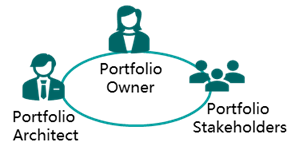
- Portfolio Owner:
- Defines strategic investment priorities.
- Manages resource allocation and prioritization decisions.
- Oversees risk management and investment reviews.
- Portfolio Architect:
- Designs scalable, reusable, and integrated technology architectures.
- Manages dependencies and technical coherence across product initiatives.
- Portfolio Stakeholders:
- Provide ongoing market and customer insights.
- Validate feasibility and strategic value of product initiatives.
- Actively challenge and refine investment assumptions.
- Agile Product Portfolio Management Process and Activities
Below are the core process and activities of Agile Product Portfolio Management:
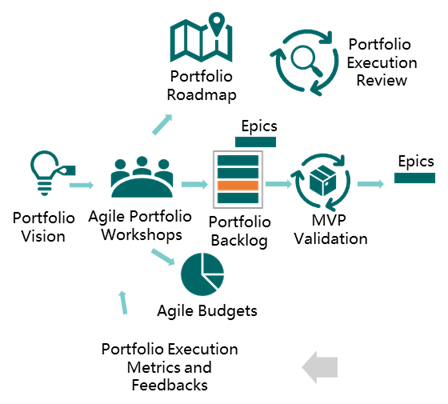
- Agile Portfolio Workshops (Quarterly)
- Input Integration:
- Strategic Themes derived from Agile Strategy and Roadmap.
- Market signals including customer research, competitive analysis, technology trend reports, and customer feedback.
- Performance metrics including financial indicators (such as Lifetime Value, LTV) and technology health (such as code quality) of existing products.
- Epic Generation:
- Decompose strategic themes into portfolio-level Epics (e.g., “Building an intelligent customer service platform”).
- Categorize Epics into investment horizons:
- Horizon 1: Optimize existing products (e.g., feature iterations).
- Horizon 2: Expand into adjacent markets (e.g., cross-border payment solutions).
- Horizon 3: Explore disruptive innovations (e.g., AI-native applications).
- Input Integration:
- Prioritization:
- Prioritize Epics using Benefit-Cost Ratio (BCR) analysis.
- Flexible Resource Allocation:
- Employ rolling budgets with 20%-30% resource reserves for rapid investment in high-potential Epics.
- Identify and mark resource dependencies (e.g., shared cross-product technical teams).
- MVP Definition and Hypothesis Validation:
- Clearly define Minimum Viable Product (MVP) scopes and key validation metrics for each Epic.
- Conduct validation experiments (such as A/B tests and customer co-creation workshops) to test critical assumptions.
- Use cross-functional Scrum teams to deliver MVPs iteratively, collect user feedback, and validate product-market fit.
- Portfolio Execution Reviews (Monthly):
- Regularly review MVP validation outcomes and product initiative performance.
- Decision-making actions include:
- Scale: Increase investments for successfully validated MVPs.
- Pivot: Modify or reduce the scope of partially validated Epics.
- Terminate: End investments in Epics failing validation.
- Monitor key portfolio health indicators, such as customer satisfaction, lifecycle value, and operational efficiency, to continuously inform investment decisions.
Value Stream Level #
Practices at this layer translate portfolio decisions into end-to-end delivery flows and close the feedback loop from operations back to portfolio governance.
- Epic Decomposition & Value Stream Mapping
Portfolio-level product Epics are decomposed and mapped to corresponding product value streams. End-to-end delivery pathways are visualized, and cross-stream dependencies and bottlenecks are identified to inform resource allocation and delivery sequencing.
- Cross-Product Architecture & Dependency Management
Led by the Portfolio Architect in collaboration with value stream architects, cross-product technical dependencies are managed and reusable architectural capabilities are cultivated. This ensures product initiatives across the portfolio maintain technical coherence and reduces redundant development and integration risk.
- Value Stream Performance Feedback Loops
Delivery performance and value outcomes are tracked at the value stream level. Structured feedback on end-to-end delivery performance and market outcomes feeds into monthly and quarterly portfolio reviews, enabling evidence-based refinement of portfolio decisions.
Team Level #
Practices at this layer align frontline delivery work with portfolio objectives and channel bottom-up insights back into portfolio governance.
- Iterative MVP Delivery & Feedback Collection
Cross-functional Scrum teams deliver MVP increments iteratively sprint by sprint. User feedback and usage data are collected continuously throughout delivery to provide empirical input for hypothesis validation.
- Sprint Goal Alignment with Portfolio Epics
Team-level Sprint Goals are aligned upward to the Epic objectives of their parent value stream, ensuring day-to-day delivery work consistently serves the overall intent of the portfolio investment and reduces strategically misaligned effort.
- Bottom-Up Insight & Feedback Channels
Structured channels enable frontline teams to surface market insights, technical opportunities, and delivery impediments upward through value stream and portfolio layers. This enriches the information base for portfolio decisions and enables bottom-up innovation to emerge organically.
Case Study: Agile Portfolio Management Transformation at a Leading Global Medical Device Manufacturer #
Context #
A leading global medical device manufacturer specializing in advanced diagnostic imaging systems and therapeutic equipment operated under a traditional annual project-based budget model. Resources were allocated once per year to predefined projects with no mid-cycle adjustment mechanism. Investment decisions relied heavily on upfront forecasting rather than market validation, resulting in approximately 30% of R&D projects consuming significant resources before being abandoned due to shifting clinical demand or unfeasible technical pathways. Meanwhile, the majority of resources were locked into incremental improvements to mature products, leaving insufficient investment for disruptive digital health and AI-driven diagnostic innovation. To improve investment efficiency and innovation capacity, the organization adopted SEM’s Agile Portfolio Management practice to restructure its product investment governance system.
Intervention #
The enterprise implemented a full SEM-aligned agile product portfolio operating model with three core interventions:
- Three-Horizon Portfolio Governance Structure: A portfolio governance committee was established comprising the Portfolio Owner, Portfolio Architect, and cross-functional stakeholders from R&D, clinical affairs, regulatory, and finance. A formal BCR prioritization framework was adopted, and target resource allocation ratios were defined across Horizon 1 (core product optimization), Horizon 2 (adjacent digital health expansion), and Horizon 3 (disruptive AI diagnostic exploration).
- Quarterly Portfolio Workshops & Rolling Budgets: Annual project approvals were replaced with quarterly Agile Portfolio Workshops. A rolling budget mechanism was introduced, with 25% of R&D resources held as a dynamic reserve to support rapid scaling of validated successes and response to emergent opportunities.
- MVP Validation & Monthly Review Cadence: All new Epics required explicit MVP scope and core hypothesis definition before funding approval. Small-scale clinical validation studies and physician co-creation workshops were used to test core value propositions. A monthly portfolio review cadence was implemented to make scale, pivot, or terminate decisions based on empirical validation data.
Outcomes #
Within 12 months of implementation, the manufacturer achieved measurable improvements in product investment performance:
- Overall R&D return on investment increased by 45%. Average resource loss on failed initiatives fell by 60%, as most underperforming projects were identified and terminated at the MVP stage before large-scale resource commitment.
- Product time-to-market shortened by 30%. In particular, Horizon 2 digital health adjunct products moved from concept to launch in under 12 months, down from an average of 18 months under the prior model.
- Innovation mix improved materially. Investment in Horizon 3 disruptive innovation rose from 10% to 22% of R&D spend, while Horizon 1 core product iteration efficiency was maintained, achieving balanced operational improvement and exploratory innovation.
- Cross-functional collaboration efficiency improved significantly. Priority conflicts and resource disputes across product, R&D, clinical, and regulatory functions decreased by 40%, driven by shared portfolio ownership and transparent decision-making.
Conclusion #
Agile Portfolio Management is the central investment lever of the Scrum Enterprise Model, transforming static annual budget allocation into a dynamic value-investment system. It does not merely improve budgeting efficiency; it rebuilds the governance foundation for sustained innovation, enabling organizations to dynamically redirect investment in response to market evidence while balancing short-term performance and long-term strategic renewal.
Within SEM’s layered architecture, it receives strategic direction from the strategic layer and empowers delivery at the value stream and team layers, creating a closed loop from strategic intent to delivered customer value. For organizations evolving from traditional project-based structures to product-centric agile enterprises, it is the defining governance capability that turns strategic ambition into disciplined, risk-managed innovation.
Across complex, fast-evolving market environments, Agile Portfolio Management is far more than a tactical management technique—it is a core organizational capability that determines an enterprise’s ability to sustain growth and competitive advantage through successive waves of technological and market disruption.


