
Conceptual Definition #
Agile Strategy is a core practice area within the Agile Strategy & Portfolio Management competence of the Scrum Enterprise Model (SEM). It is a dynamic, adaptive approach to strategic management purpose-built for complex, uncertain market environments. Integrating Lean thinking, Agile values and principles, and Scrum’s empirical framework, it enables organizations to continuously sense market signals, validate strategic hypotheses at speed, and optimize resource allocation in real time, strengthening organizational resilience and the efficiency of end-to-end value delivery.
Unlike traditional linear strategic planning anchored to static annual targets, Agile Strategy operates on a cyclical Sense-Respond-Evolve logic. It redefines the function of strategy from predicting and controlling outcomes to designing adaptive governance rules that allow the enterprise to thrive amid volatility. Within SEM’s four-layer architecture, it sits at the strategic layer as the foundational mechanism that aligns long-term enterprise vision with downstream portfolio, value stream, and team-level execution.
Purpose #
Agile Strategy serves five interconnected strategic objectives within the SEM framework:
- Shorten Strategic Feedback Loops
It transitions organizations from rigid annual planning cycles to quarterly and monthly adaptive cadences via the Build-Measure-Learn loop, using real-time market and customer data to validate strategic assumptions and reduce the lag between signal and response. - Establish Dynamic Calibration Mechanisms
It replaces linear Plan-Execute-Assess logic with an iterative Sense-Respond-Evolve process, enabling continuous recalibration of strategic priorities as internal capabilities and external conditions evolve. - Optimize Strategic Resource Flow
It directs investment along identified end-to-end value streams, grounded in value stream mapping (VSM) and Lean Startup principles, to dynamically redirect resources toward high-value initiatives and away from underperforming ones. - Enhance Distributed Organizational Resilience
It empowers decentralized decision-making and self-organizing teams to respond flexibly to local changes while maintaining cohesive alignment with enterprise strategic direction. - Institutionalize Strategic Learning
It embeds strategic retrospectives and adaptive planning into organizational routines, converting setbacks and experimental outcomes into accumulated strategic knowledge and durable competitive capability.
Agile Strategy does not seek to eliminate uncertainty. Instead, it transforms uncertainty into a source of differentiated competitive advantage through high-frequency learning and adaptive responsiveness.
Core Principles #
Agile Strategy is underpinned by six foundational principles, each aligned with SEM’s systemic architecture and Lean-Agile theoretical roots:
- Empirical Strategic Governance
Rooted in Scrum’s three pillars of transparency, inspection, and adaptation, this principle holds that strategic direction must be grounded in observable evidence rather than static forecasts. Strategic assumptions are treated as testable hypotheses, and plans are updated iteratively based on validated learning. - Sense-Respond-Evolve Operating Logic
This principle replaces linear, predictive planning models with a continuous cycle of environmental sensing, targeted response, and systemic evolution. It recognizes that in VUCA environments, long-range precision is unattainable, and adaptive capacity is a stronger predictor of long-term success. - Value-Driven Resource Allocation
Aligned with Lean’s focus on customer value, this principle dictates that resources and investment are allocated based on demonstrated value delivery and validated strategic impact, rather than on historical departmental entitlements or upfront forecasts. - Coherence Over Control
This principle balances strategic alignment and execution autonomy. Rather than imposing detailed top-down mandates, Agile Strategy establishes clear strategic guardrails and outcome objectives, allowing lower organizational layers to determine the most effective path to achievement. - Continuous Strategic Learning
This principle frames strategy as an ongoing learning process rather than a one-time planning event. Failures and unexpected outcomes are treated as valuable inputs that improve future strategic judgment, not as performance failures to be penalized. - Systemic Architectural Alignment
This principle ensures that strategic themes are mapped to organizational capabilities and underlying architecture. Guided by enterprise architecture practice, strategic initiatives are sequenced to build sustainable organizational capability rather than deliver isolated short-term outputs.
Practices Across SEM Architectural Layers #
The following practices operationalize Agile Strategy principles at each layer of SEM’s four-tier architecture, translating strategic philosophy into actionable, repeatable governance routines.
Strategic Level #
Practices at this layer govern enterprise-level direction-setting, hypothesis formulation, and cross-layer strategic alignment.
- Cyclical Agile Strategy Workshops
The core mechanism of strategic formulation, operating on annual and quarterly cadences. Annual workshops establish full-year strategic framing and alignment; quarterly workshops refine priorities, recalibrate initiatives, and integrate performance insights. Workshops draw structured inputs including enterprise mission/vision/values, market analysis, customer feedback, operational performance metrics, and capability gap analysis.
- Strategic Map & Theme Definition
The production of a formal strategic map articulating clearly defined strategic themes aligned with organizational mission and vision. This map serves as the north star for all downstream portfolio and delivery activities across SEM.
- Strategic Backlog & Roadmap Stewardship
Curatorship of a prioritized strategic backlog of enterprise-level Epics ranked by value-cost ratio, and a corresponding strategic roadmap outlining iterative execution milestones. These are living artifacts updated at each quarterly workshop cycle.
- Cross-Functional Strategic Governance
Shared governance delivered through three core roles: Enterprise Executives define vision, allocate resources, and resolve cross-functional conflicts; Enterprise Architects map strategic themes to organizational capabilities and manage cross-initiative dependencies; Enterprise Stakeholders provide empirical customer and operational feedback and identify strategic blind spots.
- Key Roles and Responsibilities
The core roles s involved in agile strategic planning as below:
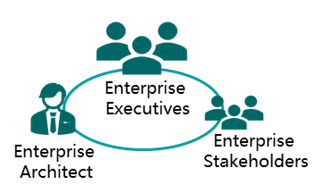
- Enterprise Executives:
- Define strategic vision and priorities.
- Decide resource allocation and resolve inter-departmental conflicts.
- Govern strategic risks and promote agile culture.
- Enterprise Architect:
- Map strategic themes to organizational capabilities.
- Design scalable, agile business and technical architecture.
- Manage dependencies across strategic initiatives and create roadmaps for iterative evolution.
- Enterprise Stakeholders:
- Provide empirical feedback from customer and operational perspectives.
- Integrate local insights to identify strategic blind spots.
- Evaluate feasibility and operational impacts of strategic initiatives.
- Agile Strategy Process and Activities
Below are the core processes and activities of Agile Strategy:
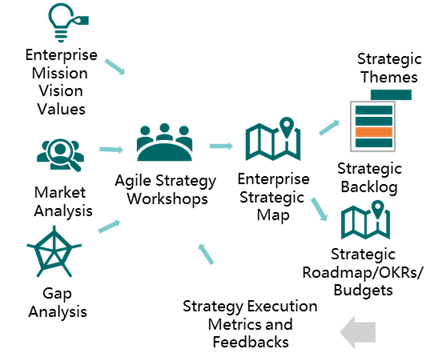
The core activity in strategic formulation is the Agile Strategy Workshop. The inputs for this workshop include:
- Enterprise Mission, Vision, and Values: Guiding principles and long-term aspirations of the organization.
- Market Analysis: Current industry trends, competitive landscape, and emerging opportunities.
- Customer Feedback: Insights from customer interactions, satisfaction, and preferences.
- Operational Performance Metrics: Data reflecting internal operational efficiency and effectiveness.
- Gap Analysis: Hypotheses generated from analyzing current capabilities versus desired future state.
Outputs from the Agile Strategy Workshop typically include:
- Strategic Map: Clearly defined strategic themes aligned with organizational vision and mission.
- Strategic Backlog: A prioritized set of strategic initiatives (Epics) based on their value-cost ratio.
- Strategic Roadmap: A timeline outlining iterative milestones for executing prioritized strategic initiatives.
Agile Strategy Workshops are conducted annually and quarterly:
- Annual Workshops: Focus on establishing comprehensive strategic planning and alignment for the upcoming year.
- Quarterly Workshops: Concentrate on refining the strategic plan based on quarterly performance reviews, adjusting priorities, and recalibrating initiatives to ensure ongoing alignment and effective response to changing conditions.
This iterative process fosters continuous adaptation, maintaining strategic relevancy and agility throughout the execution phase.
Portfolio Level #
Practices at this layer translate strategic themes into investment decisions and portfolio execution guardrails.
- OKR Cascading & Strategic Alignment
Translation of strategic themes into cascading objectives and key results that connect enterprise intent to portfolio-level initiatives, ensuring investment decisions trace directly back to strategic priorities.
- Dynamic Budget & Resource Allocation
Implementation of adaptive funding models that reallocate resources in response to validated strategic outcomes, rather than locking in static annual departmental budgets. This practice applies Lean Startup principles to fund initiatives incrementally based on demonstrated progress.
- Strategic Risk & Dependency Oversight
Ongoing monitoring of cross-portfolio dependencies and strategic risks, with formal escalation pathways to resolve barriers that cannot be addressed at the value stream or team level.
Value Stream Level #
Practices at this layer align end-to-end value delivery flows with strategic direction and close the feedback loop from operations back to strategy.
- Value Stream Alignment & Mapping
Application of value stream mapping (VSM) to connect operational workflows to strategic themes, identifying systemic bottlenecks and ensuring optimization efforts target strategically significant outcomes.
- Strategic Gap Analysis
Regular assessment of current value stream performance against strategic targets, generating improvement hypotheses that feed back into the strategic backlog for enterprise-level prioritization.
- Operational Feedback Loops
Structured channels for surfacing operational performance data and frontline insights back to strategic governance cycles, ensuring strategic decisions are informed by real-world execution realities.
Team Level #
Practices at this layer ensure frontline delivery teams operate within strategic guardrails while contributing bottom-up insights to strategic evolution.
- Sprint Goal Alignment with Strategic Themes
Translation of portfolio-level priorities into team-level Sprint Goals, ensuring day-to-day delivery work traces upward to enterprise strategic objectives.
- Local Adaptation Within Strategic Guardrails
Empowerment of teams to make tactical decisions and adapt execution approaches autonomously, within the boundaries of agreed strategic objectives and compliance requirements.
- Bottom-Up Strategic Feedback Channels
Structured mechanisms for teams to surface market insights, technical opportunities, and execution barriers upward through portfolio and value stream channels to inform strategic recalibration.
Case Study: Agile Strategy Transformation at a Leading Global Medical Device Manufacturer #
Context #
A leading global medical device manufacturer specializing in advanced diagnostic imaging systems faced growing strategic inflexibility driven by its traditional annual planning cycle. Rapidly evolving regulatory requirements including EU MDR and FDA digital health updates, shifting clinical customer needs, and disruptive market entrants had rendered static 12-month plans obsolete within months of approval. Misalignment between strategic priorities and frontline R&D execution led to delayed product launches and wasted investment in initiatives that no longer matched market realities. The organization adopted SEM’s Agile Strategy practice to rebuild its strategic management system for adaptive, evidence-based decision-making.
Intervention #
The organization implemented a full Agile Strategy operating model aligned with SEM principles:
- Cyclical Strategy Workshop Cadence: It established annual strategic framing workshops supplemented by quarterly recalibration workshops, drawing structured inputs from market intelligence, regulatory updates, clinical customer feedback, and R&D performance data.
- Strategic Backlog & Dynamic Funding: A prioritized strategic backlog of enterprise Epics replaced static annual project lists, with funding released incrementally based on validated milestone outcomes rather than upfront annual allocations.
- Layered Alignment System: Strategic themes were cascaded through portfolio OKRs to R&D value streams and delivery teams, creating clear line-of-sight from enterprise vision to sprint-level execution while preserving team autonomy.
Outcomes #
Within 12 months of implementation, the manufacturer achieved measurable strategic and operational improvements:
- Strategic response time to material regulatory and market changes reduced by 55%, with priority shifts executable within quarterly cycles rather than requiring full annual plan overhauls.
- Resource allocation efficiency improved by 35%, as underperforming initiatives were identified and defunded early, and capital was redirected to higher-value clinical innovation pipelines.
- Alignment between strategic priorities and frontline delivery work increased from 55% to 85%, measured by the share of team sprint goals tracing directly to enterprise strategic themes.
- Time-to-market for incremental medical device feature updates accelerated by 30%, supported by faster strategic prioritization and reduced administrative planning overhead.
Conclusion #
Agile Strategy is the foundational steering mechanism of the Scrum Enterprise Model, converting static, document-centric strategic planning into a dynamic, living management system that thrives in VUCA environments. By embedding empiricism, iterative learning, and value-driven resource allocation into the core of strategic governance, it closes the historic gap between strategic intent and operational execution.
Within SEM’s layered architecture, it creates a coherent alignment framework that connects enterprise vision to frontline delivery without sacrificing speed, autonomy, or innovation capacity. It redefines strategic success not as adherence to a preordained plan, but as the ability to sense change, adapt intelligently, and sustain value delivery amid continuous disruption.
For organizations operating in rapidly evolving regulatory and competitive landscapes, Agile Strategy is not merely a planning methodology—it is a core organizational capability that transforms volatility from a threat into a source of sustainable competitive advantage.


